Showing posts with label lessons. Show all posts

Wednesday, May 19, 2021

We are simply "Skipping a Stone" across U.S. History

 I talk with my students all the time about all of the U.S. History events that are contained in our 8th-grade Content Level Expectations set by the Michigan Department of Education. 
(CLICK HERE for Marzano Style Lesson Design)

I also try to explain the fact that what we cover is "One-inch deep and a mile wide on a vast lake of knowledge." Meaning that we cover a variety of topics from the Declaration of Independence, the U.S. Constitution, the War of 1812, the U.S. Civil War, Reconstruction, etc. but we don't go too deep into any of them. We cover all of those topics (and more) in a nine-month school year, whereas we could spend a semester on each of them individually. I guess that's what college is for.

I try to link events together by using a TIME WEB on my board. Right now it is just a visual of what it could look like. Next year I want to fill it in with actual events showing how certain events are linked to other events and how personal experiences helped shape our history, just like our personal experiences shape the way we live our lives.

Continuing with my, "One-inch deep and a mile wide" analogy, sometimes I feel like we are simply skipping a stone across the vastness of U.S. History. We are just skimming the surface on certain topics while ignoring the depth underneath. I try to make the biggest waves, while also acknowledging the ripple effects and how, when they collide with ripples from other stone touches, other events were born.

My hope is that on the topics we do dive deeper on, specifically the Declaration of Independence and the U.S. Constitution, I am providing the bedrock that our Nation is founded on so that my students will have a better understanding of our History when we only have time to skip that rock.

www.johnvandusen.com


Tuesday, February 23, 2021

Time Web

 While I love teaching 8th grade U.S. History, I do with I hade more time so that my content wasn't, "a mile wide and an inch deep." So many of our topics are intertwined and deeper than the one or two days we get to spend on them. I am trying desperately to make connections in history stick together.
Enter:

The TIME WEB

I talk to my students all the time about how the points in history that we study are all interrelated. History isn't so much a TIMELINE as it is a TIME WEB, with events linking to other events happening at the same time, in the future, and in the past.

Today in class was a great example. While talking about the Missouri compromise and California statehood, a bunch of different points in history that we have already learned about came into play. Thomas Cobb, James Tallmadge, and John Q. Adams all predicted the civil war decades before it would take place.

We brought up the revolt of Nat Turner and how that led to first amendment issues in Mississippi when them offering a reward for the arrest and conviction of any person "who shall utter, publish, or circulate" abolitionist ideas.

We talked about how the women's rights movement, the temperance movement,  and public school reform all helped lead to the abolition of slavery. We talked about the tabling of slavery issues by congress, basically, "kicking the can down the road." We also talked about what it meant to, "Make a motion" and "Table" something.

We recalled the U.S. - Mexican war and how it was brought on by the annexation of Texas. It helped us to, "REMEMBER THE ALAMO!" and General Santa Anna. When President Polk asked for money for the war, David Wilmot of Pennsylvania brought up a Proviso that would ban slavery in any territory that was gained as a result. 

The gold rush to California in 1849 and the follow-on application for statehood as a free state-linked us back to the Missouri compromise and the "line in the sand" at the 36 degrees 30 minute parallel and why it wasn't drawn all the way to the Pacific ocean.

Our TIME WEB got a workout today, linking the founding of our Nation with several historical stops along the way on our mile-wide, inch-deep journey. Days like today make me feel like we are simply skipping a rock across the pond of history, touching only key points, and leaving out other vital topics.

My hope is that my 8th graders learn to love learning and make connections of their own.

Sunday, February 21, 2021

Messy Desk

What does your desk look like?

Some days my desk looks great! I take 8 min. and put things away, throw away un-needed times, and I look really organized. Other days, it's not like that.  Why does it matter? Or does it?

Albert Einstein said, "If a cluttered desk is a sign of a cluttered mind, of what, then, is an empty desk a sign?"
My desk is cluttered and my mind is not empty!
As for your desk, I think it depends on what your desk is used for:

  • Primary workstation. You spend the vast majority of your time at your desk because that's where work gets done. When I was working full time for the Army as an assistant operations officer, this was how my desk was used. My life revolved around phone conferences, PowerPoint slides, Email, and producing orders.
  • Supplementary workstation. You spend time at your desk, but it is used to enhance your job. This is how my desk is used as a teacher. I do work here, but most of my work is done away from my desk.
  • Nonworkstation. You have a desk because you need a place to put some things, but you don't do any work there. This was my desk as a Company Commander in the Army. I basically used my desk as a place to put things while I went from task to task.

Taking a look at my desk today, I see a couple of coffee cups, a binder from the class I just got done teaching (on-line course for the Army), a few dry-erase markers, my Rocketbook (Check out my video on using Rocketbook), my keys, a bottle of cleaner, a 3D printed pencil holder with applicable pencils, pens, screwdriver, fork (what is that doing there?) and a checklist that I am currently working on.

This is definitely a supplementary workstation. When students come in tomorrow, I will use my desk for taking lunch count, attendance, and starting whatever prevention we will be working on. I will spend some time at my desk tomorrow, but most of my time will be spent away from my desk talking with and helping my students.

When teachers went from face-to-face to virtual, there were some massive changes in regards to our desks. First, our desk went from our classroom to our home. When we are in our classroom, our space is geared toward teaching, when we are at home, it is not. 

Where was your desk?

Mine was at first in the kitchen. I hung a sheet up in between the windows to help knock down some of the echoes. Second, it moved to our spare bedroom, again with a sheet hung up behind me. I look back at some of those early recordings and I laugh at how ridiculous it looks!

I ended up placing my computer in the basement on my workbench so I could stand most of the time. It was really tough to get organized at home without a primary workstation desk.

Clutter Helps

I think that having a desk with some clutter on it helps me manage my work. I tend to bounce around from task to task and by having "everything out" I remember things I need to do. About once a week my desk gets a good cleaning. Things get thrown away, put away, placed in places of priority so I remember to do them. 

How do you use your desk?
What does it look like?


Wednesday, April 11, 2018

Change in Plans

Teaching, much like life, throws us curve-balls now and again.
Sometimes those result in a a, "STIIIIIIIIRIKE!"
Other times we hit a home run....this week has bee a HOME RUN!
(See the baseball reference....)

Coming back from spring break (I had one day of break due to working for the Army...whomp whomp) I had the idea of getting out our Keva planks and building some bridges.  We haven't done that in a while. We have been doing a lot of brain work lately with dice and cards, and clay. I wanted to get some things moving with building and breaking things.

When I came into my room, I was happy to find some things I had ordered showed up!  Two big kits of K'Nex and some laserclasrroom light kits.  I received some ZOOB's earlier in the month and had been waiting on the K'Nex to show up so we could do stations.

I threw my bridge idea away and within about 15 min. had a plan to work with our new toys.
It has been a riot watching my students explore with our new gadgets!

I took the light kits to the middle school and it has been great watching 5th graders work together on different light experiments.

As always, you can see more on Twitter.

Tuesday, December 19, 2017

Better than a Video Game!


he last few weeks I have been trying to give my students some tools to use over Christmas break. I have been giving them simple STEM games that they can play at home either by themselves or with a few friends/parents/relatives/people/whomever. 
Two weeks ago we played "STUCK IN THE MUD" and "KNOCKOUT." Both simple dice games that reinforce the idea of probability. My students had a blast playing, and I had a few come back and say that they had played at home.  You can see my score sheets HERE! Make your own or print these off!


This week we are playing a simple form of YAHTZEE!  I have it scaffolded for EK/K/1, 2/3, and 4th grade. With the younger students I only give them two dice and one roll. The middle group gets three dice and two rolls, while the 4th graders get five dice and three rolls. It has worked well! I was a little concerned (as I often am) with the EK and K groups, but they are adding and having fun. I know that my students will have screen time this Christmas break, but my hope is that they will put the iPad down for a fun STEM game with some of their friends
.

Tuesday, December 5, 2017

Probably = Probability

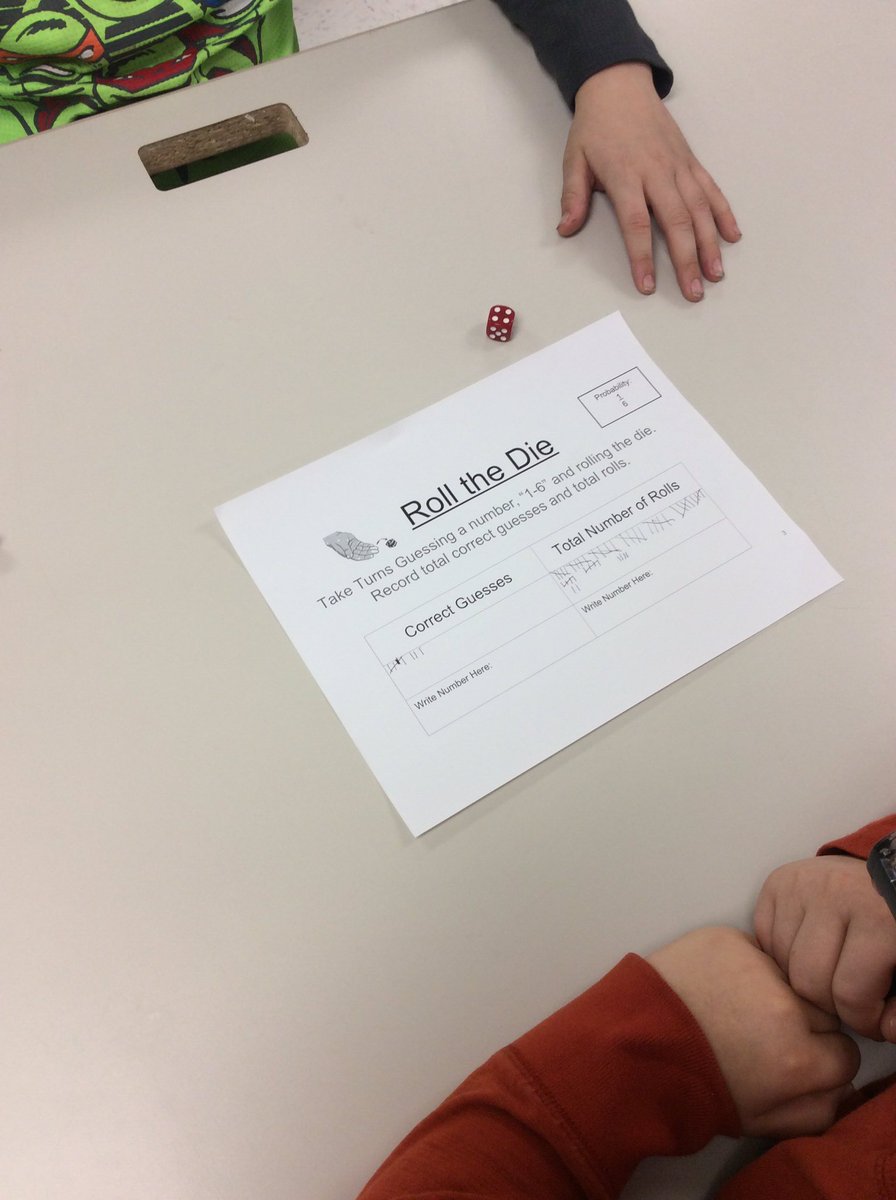
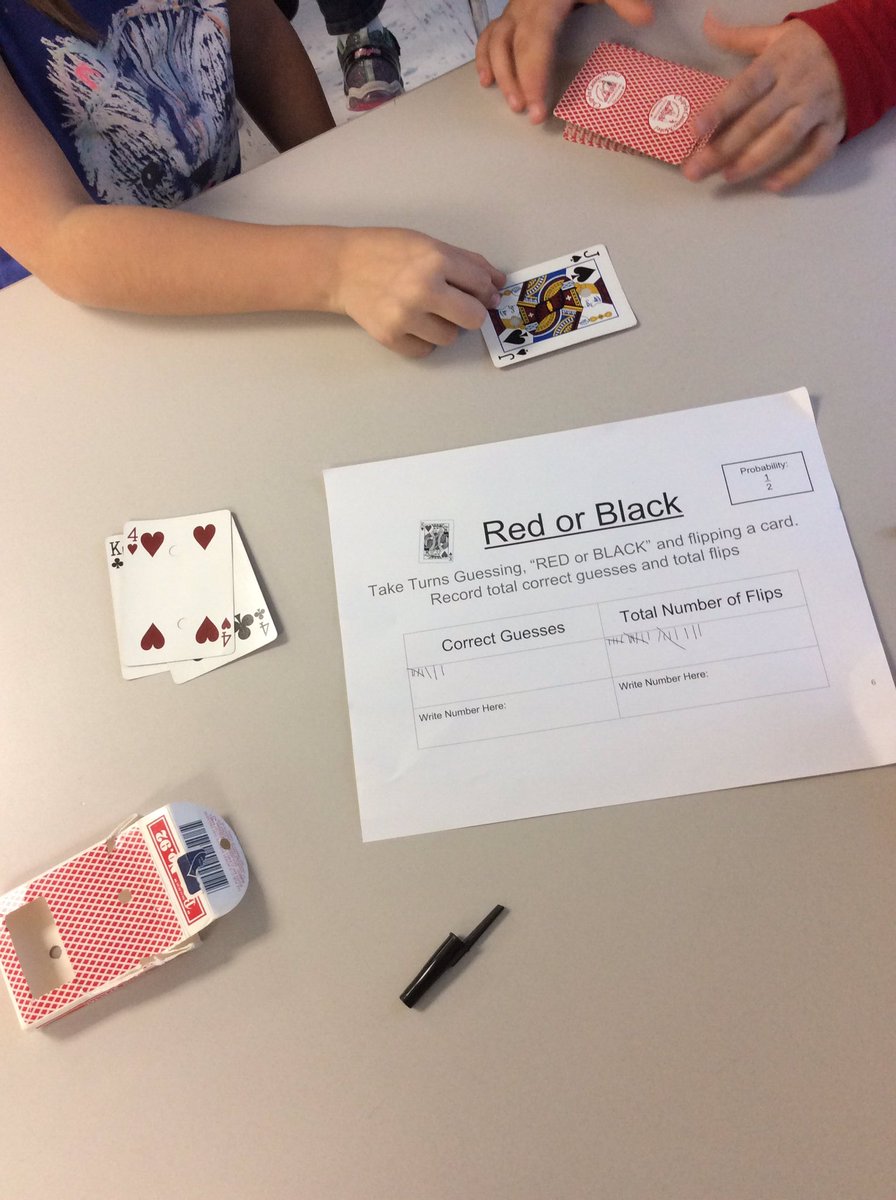
Working with probability the last two weeks has been a lot of fun!
We have been flipping quarters, rolling dice, and shuffling cards.
1) Flipping a quarter. There are only two things that can happen, heads or tails.  That seems simple enough. Last year I had 5th graders flip a quarter 5,000 times.  We ended up with 2,495 heads and 2,505 tails. Only 5 away from perfect probability.  This week we have seen some funny things happen. As a demonstration, I will flip the quarter 10 times.  Sometimes I go 5 and 5, other times 6 and 4. One time I flipped 8 heads and 2 tails.... but why?
2) Rolling a die. This has been a lot of fun. For some reason, elementary students (mine anyway) LOVE to roll dice! Probability? 1 out of 6. We haven't had a lot of crazy things happen with the die, other than I watched a 3rd grader go 4 for 4 on guessing the right number! How?
3) Shuffling cards. We have two games we play with this. The first one we try to guess if it will be red or black (1/2 probability...same as the coin). The other game is to try and guess the number (A, 2-10, J, Q, K....1/13 probability) The red or black game is fun, but the guess the number game is really interesting. It goes back to my post about "PREPARING TO FAIL." Most students understand the 1/13 chance of getting the right answer and are okay when they get it wrong. Other students are not and it ruins their entire day. Trying to manage expectations is an interesting animal with a 6 year old.

If you would like to play, you can check out the handouts here: Probability Handout

Do all this!! https://twitter.com/Mr_JVD https://mrvandusen.blogspot.com/ https://www.facebook.com/breitungtown... https://www.facebook.com/woodlandbts/


Thursday, October 26, 2017

SPOOKY SKELETONS!!!

Because it's close to Halloween, we HAD to do something fun with skeletons! It's pretty neat to see what students already know about bones, and how much they don't know!  I have had a few classes that were able to name the largest bone in the body (Femur for those who didn't know....no judgment here.) I have had ZERO classes able to name the smallest bone (Stapes..it's in your ear.) We had some "homework" to do while watching our skeleton video.
1) Where is the largest bone in the body and what is it called? (Upper leg - Femur)
2) Where is the smallest bone in the body and what is it called? (Ear - Stapes)
3) How many bones make up your skull? (21)
4) What do bones make? (Blood)
Then we had some fun making skeletons!
We started by making legs, then arms, then a rib cage.
The grand master challenge was to make an entire skeleton out of our Keva Contraption blocks.
Check me out on TWITTER for more pictures!

Tuesday, October 10, 2017

Christopher Columbus: The worlds biggest FAILURE!


Image result for christopher columbus proposed route
Watch his story here!
With Monday being Columbus day, I thought it would be a great week to talk about one of the biggest failures of all time!

Floating Easy
That may seem harsh, but Christopher Columbus failed miserably at his mission.  He was trying to get to India.  He missed by about 15,000 miles. Not his fault though!!  He thought the earth was a lot smaller than it really is.  It's hard to fault a guy for that when most of the world still believed that the world was flat!  Almost everyone he came across told him he was crazy for one, thinking the earth was round, and two, for wanting to go sail off the edge of it. 

So how do you celebrate a man who failed.  Easy! Christopher Columbus may have failed at his attempt to find the West Indies, but he was brave enough to try! He could have listened to his critics and not tried at all, but, because he was persistent, he opened up trade routes with the Americas and is credited as the first European to set foot on these new lands. 
It's SINKING!
He tried so hard, that he succeeded, even in failure.

The boats come in all shapes and sizes. A few students have realized (Sometimes before and sometimes after) that a wider boat works better. Next lesson? Displacement! HA!

The main lesson this week is that even when the world (flat or round) is against you, you should always go with your dreams. Even if you fail, you may end up doing something extraordinary.

There is saying that says, "Shoot for the moon. Even if you miss you'll land among the stars."
That's what Columbus did. You should too.

See more on TWITTER!

Friday, October 6, 2017

All About Apples!

The Kindergarten class went to an apple orchard for their field trip last week.  I thought it would be a PERFECT time to have a lesson about apples.

We watched a short video about how apples go from the tree to the store. (Watch it here) It is DEFINITELY for kids, but it's very informative and the students seemed to enjoy it. They especially liked the "apple river" and sticker machine.

Then we tried to build apple trees. We completed all 5 parts of the, "APPLE STACK CHALLENGE!" If you would like to try the Apple Stack Challenge, here are the Google Slides.  Feel free!

Building the apple trees was a lot of fun. I made a video of all the challenges here.

I was surprised while talking about apples how many students DIDN'T like applesauce....  Even less like applesauce with cinnamon.
I was NOT surprised at how many students liked apple pie, apple crisp, and caramel apples.
It seems that somewhere around 1st grade is when students start to experience apple cider.
Apple cider is one of my favorite drinks on a cold, winter day.

Learning all about apples this week has not only been a lot of fun!

See more on TWITTER!!

Friday, September 29, 2017

Football / Life Lessons

Follow the Flivvers on Facebook
Coaching football has taught ME some very valuable lessons. These lessons held true at Gwinn, L'Anse, and here at Kingsford.

I have learned to never (ever) assume that players know what I'm talking about:

"We need to shift into cover three when they show us twins to the boundary."

Blank stares. Gotta put that on the white board, show it on the field, then show them on film VanDusen!

I have learned to over simplify things. A thinking teenager is a slow teenager. I want my players to play fast which means I have to make the thinking easy and/or non-existent.

More importantly, I hope to teach young men valuable lessons.  Not only about the game of football, but also about life.  Here are three lessons that have been prevalent this past season.  They are in no particular order, and this list is FAR from inclusive.

1) Master things that take no talent.  This isn't my quote, but I absolutely love it. In football, this means watching film, reading scouting reports, going hard every play, etc.  Every football coach I know has a story of a player who had the heart of a lion. He gave absolutely everything he had to the game, yet never got very far due to a lack of talent. That player is usually a coaches favorite, despite the lack of output.  This player, although they may not be a great football player, will succeed in life because they are attempting to master the things that take no skill. They will find their skill, whether it's being a plummer, lawyer, or teacher.  They will find out their skill and their mastery of talent-less skills will serve them well. of In life it can mean being to work on time, driving without distraction, and paying bills on time.

2) You play exactly how you practice. One of my favorite stories (I don't know if it's true or not...) comes out of Iraq in 2003.  A group of American Soldiers got into a small gunfight. Prior to getting back in their trucks and moving to the engagement area, a young Soldier stooped over and began picking up his brass. His sergeant yelled at him to get back in the truck and he did, but a VALUABLE lesson was learned.  In training, that Soldier would take the extra minute or two to pick up his brass, because when the training event was over, they would have to go pick it up anyway to turn it in.  He was fighting exactly how he trained.
In football, however you practice, that is how you play. Do you carry out your fakes? Do you block till the whistle? Do you force your players into a tight huddle?  Whatever you do on the practice field, expect it on game night.

3) You can't control what happens to you, you can only control your reaction to it. (Again, not mine, but I love it!) Last night, our quarterback rolls to his left on the second play of the game. He spies an open receiver, squares his hips, cocks the ball and begins his throwing motion. The ball slips out of his hand and the defender who was chasing him down from the back side had a gift land right in his hands. He returned it for a touchdown and we go down 6-0.  We couldn't control the rain making the ball slick. We couldn't control the defender ripping through a great block and pursuing from the backside.  We couldn't control the fact that he was able to take it back for six points.  All we could control was our reaction to it. 
So what did we do?  We got a great kick return. Ran three plays for 45 yards and a touchdown.  Then we scored the two point conversion. Now we are winning 6-8. I like that reaction.
In life all kinds of crazy things can happen. You can set the conditions to be in your favor, but at the end of the day, you can't control what happens to you. Flat tire. Car accident. Hail storm damaging your roof. What are you going to do about it?

I love football.
It is an amazing game and I have build some incredible relationships with coaches and players that I couldn't have anywhere else.

Aaron Rodgers was quoted in ESPN magazine as saying, "I hope I don't just do this."
He said that after winning the Super Bowl. (Read the Article Here)

I can reflect on the past 10 years of coaching and know that I do more than just football. Some days my day seems DOMINATED by football, and it is.  But I also know that those young men who snap their helmets on every week are learning lessons that will help them do more than, "this."